
Injectable lip fillers are one of the most popular dermal filler procedures. Hyaluronic acid injections increase lip volume. As with any cosmetic procedure, patients should have realistic expectations.
Several types of dermal fillers can be injected into your lips and around your mouth. The most commonly used injectable fillers include substances similar to hyaluronic acid. Hyaluronic acid is naturally found in the human body.
Some of the most popular brands of lip fillers are Restylane®, Juvederm®, and Perlane®.
The lips will swell immediately after filler injection. Swelling typically lasts 3-4 days, but the degree and duration of swelling varies considerably between patients. Mild bruising is not uncommon. Pain is minimal.
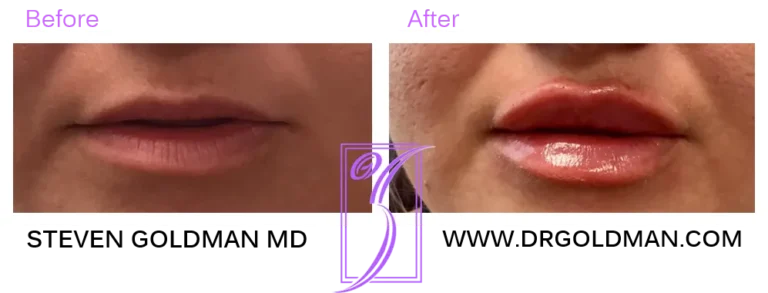
Patients will often describe the swelling as “ducky” and may feel that the swelling is noticeable to others initially, although patients typically go back to work the next day. Mild bumpiness occurs occasionally and usually resolves with massage, otherwise patients should not massage their lips.
There are no restrictions after lip injection, although alcoholic beverages may increase swelling, and most patients wait until the next day to resume strenuous activity. Longevity of the enhancement is also highly variable between patients, but most patients feel filler will last 6 months or more.
There are several benefits to lip injection procedures, including:
While there are several advantages to lip injections, there are some minor side effects, as with any skin care or medical procedure. While these treatments typically have minimal risks, there may be some adverse reactions, which include:
Lip filler injection is one of the most popular forms of facial filler injection. Patients may be motivated by a desire for improved lip shape (usually emphasizing a cupid’s bow shape), for volume augmentation (which can be subtle or dramatic), or for minimization of lip lines (often as part of comprehensive facial rejuvenation, addressing multiple areas).
Lip filler procedures are typically associated with more swelling and discomfort than injection elsewhere in the face, but this is nonetheless well tolerated. Patients can return to work and exercise whenever they are comfortable but typically wait one day for strenuous exercise and may avoid social situations for a few days. Swelling is common after injection. Most patients won’t have noticeable bruising, but it’s not uncommon. Both are highly variable between patients.
Patients should wait several hours to exercise after a lip filler procedure to minimize bruising, swelling, and discomfort. Most patients will exercise the next day.
Exercise increases blood flow, blood pressure, and body temperature. This can increase swelling from lip filler injection. (For similar reasons, alcohol should be minimized after injection.) Patients typically hold off exercise if their lips are significantly swollen or feel tight. Most patients will wait until the day after injection to work out, but this is variable.
Bruising typically occurs just during the injection itself, so exercise likely does not affect bruising a few hours after treatment. Swelling therefore is more likely to limit exercise than bruising.
There is also debate about whether exercise could cause migration or resorption of filler if performed too soon after injection. This is theoretically possible and is another reason to wait at least several hours after an injection to exercise.
Lip fillers typically last about 6 months, but this is highly variable patient to patient. Fillers tend not to last as long in older patients with thin lips.
Fillers don’t typically last as long in the lips as elsewhere in the face, perhaps because the lips are more vascular than other sites, because there is more movement in the lips, or because the lip tissues are looser than the facial skin.

Older patients with thin, deflated lips, sun damage, and lip lines may need more filler initially and may see a shorter longevity of their result because they need more volume than a younger patient with fuller lips. Conversely, a young patient who wants a large volume augmentation may also need more frequent augmentation to maintain a large volume. Young patients may metabolize filler faster, but this is theoretical.
Newer injection techniques and newer fillers designed for the lips have increased the longevity of lip enhancement. Most patients will feel that the filler lasts at least 6 months. It’s not uncommon for patients to get a year out of their injection, but most patients won’t have this long of a duration. Also remember that patients may desire more filler before their last injection has worn off.
Dr. Goldman has taught advanced injection techniques for several filler companies. He is one of the few triple board certified plastic surgeons in the world; he is board certified in Plastic and Reconstructive Surgery, Facial Plastic Surgery, and Otolaryngology/Head and Neck Surgery. He has refined (and continues to finesse) his injection techniques to produce dramatic but natural results. The stigmata of the over-injected, obviously filled celebrity-type look is not tolerated by today’s sophisticated cosmetic injection patients, who desire to look like themselves, only enhanced.
Dr. Goldman has trained his expert injectors (our nurse, nurse practitioner, and physician assistant) in his esthetic. After extensive training and under his supervision, our expert injectors have developed their own loyal clientele. All of our injectors take the time to thoroughly evaluate every patient to optimize their treatment based not just on their physical characteristics but also on their personal goals.
Because our office is one of the most comprehensive in the country in terms of surgical and non-surgical treatment options and technologies, we can also help patients determine which treatment options (or combination thereof), surgical or non-surgical, are best for them. Contact The Surgeon’s Spa – Beachwood or The Surgeon’s Spa – Westlake for a consultation.