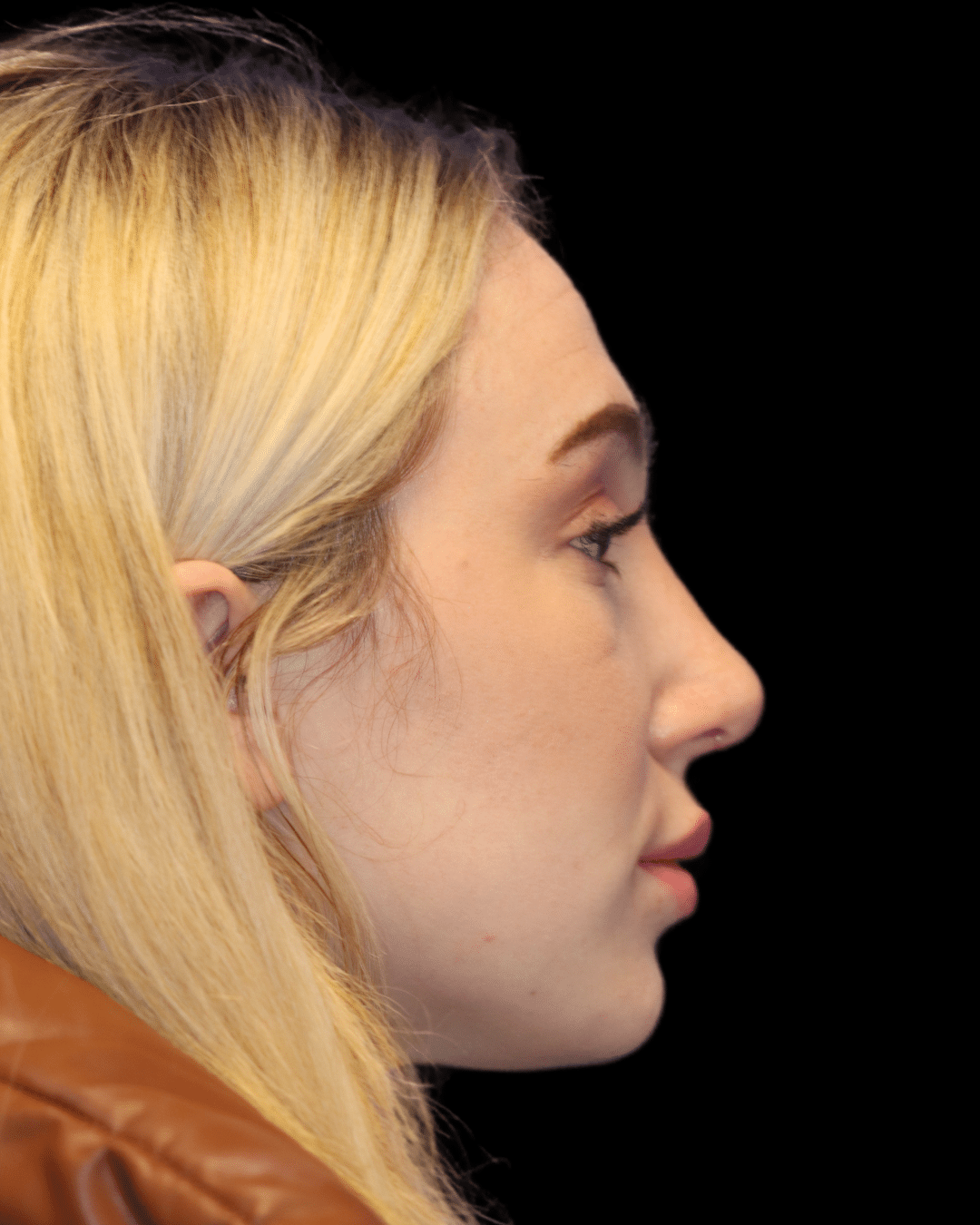
The best rhinoplasties do not look like rhinoplasties. Dr. Goldman's philosophy is to individualize each patient's treatment to create a result that is harmonious with their face or body. No two cosmetic procedures are therefore the same. This is especially true with rhinoplasty.
Dr. Goldman is a rhinoplasty specialist and is triple board-certified in facial plastic surgery, plastic surgery, and ear, nose, and throat (ENT) surgery, making him uniquely qualified for this procedure. More importantly, he is committed to personalized, compassionate patient care. He is well-known for his technical skill and artistic sense in creating dramatic but natural looking aesthetic enhancements.
Whether you are seeking cosmetic refinement, improved breathing, or both, Dr. Goldman develops a personalized surgical plan designed around your facial anatomy, functional needs, and aesthetic goals.
Rhinoplasty, commonly known as a nose job, is a surgical procedure designed to reshape the nose to improve both its appearance and, when needed, its function. As one of the most intricate cosmetic surgeries, rhinoplasty requires a delicate balance between achieving a noticeable, dramatic result and ensuring that the outcome looks natural and harmonious with the rest of the face.
Rhinoplasty can address a variety of concerns, including a hump or bump on the bridge of the nose, crookedness or asymmetry, excess width or roundness of the nasal tip, a drooping nasal tip, disproportionate nasal size, or other issues. For many patients, rhinoplasty is also an opportunity to improve nasal breathing. Internal blockages or other structural issues can be addressed at the same time as the rhinoplasty.
Because every nose is unique, rhinoplasty is never a one-size-fits-all procedure. Patients generally seek decisive correction of their esthetic concerns but want their results to look natural, not surgical. Dr. Goldman believes in achieving dramatic but natural results. Many patients want to optimize nasal breathing in addition to enhancing esthetics. Some patients are concerned with breathing difficulties caused by a deviated septum, nasal valve collapse, or previous injury. In most cases, both cosmetic and functional goals are addressed during the same surgery.
Multiple technical variations of rhinoplasty exist, so it is important to understand your options. During your consultation, Dr. Goldman and his team will explain these methods in detail and develop the ideal surgical plan for you based on your physical characteristics and personal preferences. Each rhinoplasty is tailored to the individual patient.
Dr. Goldman utilizes both open and closed (endonasal) rhinoplasty approaches. The open approach uses a small incision on the columella (the skin bridge between the nostrils at the bottom of the nose). This small scar is rarely noticeable to others and heals quickly, so it does not constitute a significant difference between the two techniques. The closed approach utilizes incisions entirely within the nose. From a recovery standpoint, the main difference between the two approaches is that the open approach generally has more swelling at the nasal tip.
The open approach is generally considered a more powerful technique, allowing more control in performing aesthetic changes to the nose. Patients who require more significant aesthetic enhancement, especially changes to the nasal tip or correction of crookedness, generally benefit from an open rhinoplasty. Patients who need more minor or subtle changes are often candidates for an endonasal rhinoplasty.
There is no single "best" technique. The appropriate approach depends on your anatomy, your surgical goals, and the complexity of the changes being made. During your consultation, Dr. Goldman will explain which approach is best suited to your needs and why.
Options are always discussed with you.
Whether your goals are cosmetic, functional, or both, the best way to determine if rhinoplasty is right for you is through a personal consultation with Dr. Goldman. During your evaluation, he will assess your nasal anatomy, discuss your concerns, and develop a treatment plan tailored to your individual needs. For out-of-town patients, virtual consultation is available.
Because every patient's anatomy and goals are unique, Dr. Goldman carefully customizes every rhinoplasty to achieve natural-looking, harmonious results that complement the rest of the face.

Rhinoplasty is one of the most technically demanding procedures in plastic surgery, requiring both surgical precision and an artistic understanding of facial balance. Dr. Steven Goldman offers patients a unique combination of experience, advanced training, and personalized care.
Patients choose Dr. Goldman because he offers:
Dr. Goldman's philosophy is simple: the best rhinoplasty is one that dramatically enhances your appearance without looking surgical or fake. His goal is to create results that feel authentic to you while improving both form and function whenever possible.
If you are ready to explore how rhinoplasty can enhance your appearance and improve your nasal function, schedule a consultation with Dr. Steven Goldman. During your consultation, Dr. Goldman will take the time to understand your concerns and discuss the best approach to meet your aesthetic and functional goals.
Rhinoplasty, often called a nose job, is a surgical procedure that reshapes the nose to improve its appearance and/or function. It can correct concerns like a bump on the bridge, crookedness, a drooping or wide nasal tip, or breathing issues caused by structural problems.
You may be a good candidate if you are in good overall health, have fully developed facial bones (typically after age 15–16), and are seeking improvement—not perfection—in nasal appearance or breathing. A consultation with Dr. Goldman is the best way to determine candidacy.
Dr. Goldman uses both techniques depending on your anatomy and goals.
If you have an open rhinoplasty, there may be a small scar at the base of the nose, but it usually fades well and becomes barely noticeable. Closed rhinoplasty leaves no external scars.
Initial recovery typically takes 1 to 2 weeks, with most patients returning to work or school during that time. Swelling can take several months to fully resolve, especially around the nasal tip. Final results are typically visible within 6 to 12 months.
Yes. Rhinoplasty can improve nasal function when internal structures such as a deviated septum or enlarged turbinates are addressed during the procedure. Dr. Goldman’s background in ENT (ear, nose, and throat) surgery makes him especially qualified to treat both cosmetic and functional concerns.